

A Spatialized Visual Translation of Sound, Memory, and Resistance
|’n Art| gallery is honoured to present and promote Ecos del Eternauta, a profound collaborative project between Greek visual artist Yannis Papayannis and Franco-Argentine composer Andrea Cohen.
Following its audio world premiere at Festival Futura (Crest, France) in 2025, Ecos del Eternauta travelled to the Festival Cervantes Electroacústico (Teatro Nacional Cervantes, Buenos Aires, Argentina) in August 2026.
Alongside the presentation in Argentina, Yannis Papayannis has realised a striking visual counterpart: a continuous large-scale painting executed on a roll of paper measuring 75 x 640cm.

This expansive visual-musical synthesis finds its genesis in Andrea Cohen’s primary ten-minute electroacoustic composition of 2025.
Drawing inspiration from Héctor Germán Oesterheld and Francisco Solano López’s landmark 1957–1959 graphic novel El Eternauta -a foundational pillar of Latin American culture and an eternal reflection on anonymous authoritarianism- Andrea Cohen’s sonic work translates the psychological landscape of survival into an atmospheric auditory journey.
At |’n Art| gallery, we take considerable pride in our long-standing collaboration with Yannis Papayannis and our steadfast commitment to championing projects of exceptional conceptual depth and artistic singularity. Ecos del Eternauta stands as a testament to the distinguished character and uniqueness of the visionary creative endeavors the artist brings to life.
The Architecture of the Work: Time Made Tangible
The dimensions of Yannis Papayannis’ canvas are governed by a rigorous structural principle: each centimetre corresponds precisely to one second of Andrea Cohen’s electroacoustic score. Rather than merely illustrating the music, Yannis Papayannis enacts a rigorous physical translation across the canvas where the painting and the composition function as equivalent objects perceived through different sensory modalities.
The work is structured as a dual-layered dialogue:
- The Narrative Layer: A figurative drawing derived entirely from Oesterheld’s literary narrative of El Eternauta, conceived independently of Solano López’s original illustrations through the artist’s own perspective.
- The Sonic Layer: An expressive chromatic orchestration applied directly over the drawing using colour, mark, and gesture. Through this physical intervention, Yannis Papayannis visually embodies every category and category shift of sound within Andrea Cohen’s score -from the sweeping vertical ribbons of the opening movement to the chilling desolation and swirling chromatic marks of the urban landscape.
The Anatomy of the Work: Structural Breakdown Across Four Movements
Curatorial Analysis: Nelly Fili
(This critical analysis and curation of the works were based on the primary conceptual rationale and notes of the artist Yannis Papayannis.)
Following the exact architectural arc of the musical composition, the 640cm roll unfolds across twelve distinct narrative moments distributed through four sections:
The Overture (0:00–2:15, 135cm): Spanning the initial 135 centimetres of the scroll, this opening movement establishes an immediate, pervasive atmosphere of tension and impending disruption. On the left, The Ordinary Night depicts four figures gathered around a card table beneath a glowing domestic lamp in a warm interior, wholly unaware of the external shift in reality. On the right, The Snow Begins manifests as a dense, dark expanse punctuated by rhythmic white dots and sweeping vertical marks, capturing the silent, lethal descent of the extraterrestrial snowfall that claims its first victim. Throughout this panel, Yannis Papayannis weaves the chromatic layers of Andrea Cohen’s score, accompanied by the earliest, subtle emergence of the gold bandoneon motif.
The Ghost City (2:15–5:40, 245cm): As the most extensive section of the scroll, this movement maps the eerie desolation of a transformed urban landscape under a relentless, patterned blanket of white snowfall. Across this 245-centimetre span, Yannis Papayannis constructs a chilling visual sequence: The Sealed House, depicted through looming, grey-toned architectural facades that alter the domestic sphere; The First Expedition, portraying figures in protective suits venturing cautiously into dead, snow-dusted streets; Buenos Aires Emptied Under Snow, where Juan Salvo stands alone as a solitary silhouette, his exhaled breath marking the sole proof of life amidst the gloom; and The Resistance Forms, signaled by dynamic, swirling chromatic ribbon marks that cut across the desolation to suggest the tentative regrouping of survivors.
The Monsters (5:40–6:34, 54cm): Compressed into a concentrated, high-intensity minute, this section visually encapsulates the hierarchical terror of the extraterrestrial invasion across a 54-centimetre panel. Yannis Papayannis maps three distinct, densely layered tiers of menace into this space: The Gurbos, depicted as massive, horned and spiked colossal entities dominating the upper zone as an oppressive background; The Cascarudos, rendered as swarming armoured beetles clustered along the lower base; and The Manos, acting as humanoid intermediaries positioned between them amidst vibrant green vertical strokes and expressive chromatic accents that embody the direct instruments of control.
The Return and the Dream (6:34–10:00, 216cm): The concluding movement draws the narrative toward an introspective and haunting resolution across a 216-centimetre panel. Yannis Papayannis maps this final journey through three striking episodes: The Return, where the domestic sphere is transfigured with an empty green card table beneath a glowing, vortex-like hanging lamp and vacant chairs; The Temporal Fracture, employing formal Cubist-inspired planes that shatter the green surface across the middle to represent simultaneous temporalities; and Los Ellos — The Faceless Power, presenting an institutional table with empty seating, a lone hand holding a telephone receiver, a bare bulb, and a door slightly ajar. The scroll resolves into forty-five centimetres of neutral grey at the far right: the residual, silent space where someone was.
Throughout the entire expanse of the work, the bandoneon -interpreted by the artist as the inner voice of Juan Salvo- is rendered in lustrous gold, maintaining an unbroken presence from the initial centimetre to the final edge.
Central to this achievement stands the quiet grandeur of Franco-Argentine composer Andrea Cohen: a master of electroacoustic art whose evocative sonic architecture transforms monumental cultural memory into an immersive auditory landscape.
By bridging Yannis Papayannis’ visual interpretation and Andrea Cohen’s formidable musical vision, Ecos del Eternauta transcends traditional sensory distinctions. It achieves a synthesis of sound and space rarely encountered in contemporary culture.
Our gallery is particularly drawn to artistic undertakings of a singular, uncompromising nature -works that push the boundaries of contemporary curatorial practice, dissolve disciplinary borders, and engage with enduring historical and cultural narratives. Ecos del Eternauta exemplifies the |’n Art| gallery’s cultural mission and visionary scope to present and promote works that permanently reshape how we encounter history, art, and collective memory.
About the Artists

Andrea Cohen is a Franco-Argentine composer and pianist born in Buenos Aires. A trained classical pianist, she arrived in Paris in 1974, where she obtained degrees in piano and chamber music from the École Normale de Musique de Paris. She subsequently studied composition with Michel Philippot and electroacoustic composition at the Conservatoires of Pantin and Vitry-sur-Seine, while also studying theatre at the École Jacques Lecoq. Her encounter with the Atelier de Creation Radiophonique on France Culture directed her toward radio art, a field in which she has worked extensively with Radio France, producing experimental sound works and documentary creations. She holds a doctorate in music and musicology from Paris IV (2005) and is the author of Les compositeurs et l’art radiophonique (INA–L’Harmattan, 2015). Her notable compositions include L’idée du voyage (2010), Le son de Luc (2014), Mille Hertz (2020), Piano Hörspiel (2023), and Ecos del Eternauta (2025).
Photo by Hugo Passarello Luna
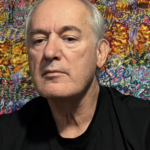
Yannis Papayannis is a visual artist based in Athens, Greece, whose artistic practice centres upon the ambitious translation of contemporary classical and electroacoustic music into large-scale, structurally unified paintings. His work is showcased internationally through |’n Art| gallery.

Archaeologist – Art Historian | Museologist | Curator nellyfili@n-art.org
Founder of |’n Art| Art & Publishing House www.n-art.org
Art and Publishing House
Art Gallery – Trading – Auctions
Archaeology – Art History | Museology | Curating
Museum and Gallery Management
w: n-art.org


